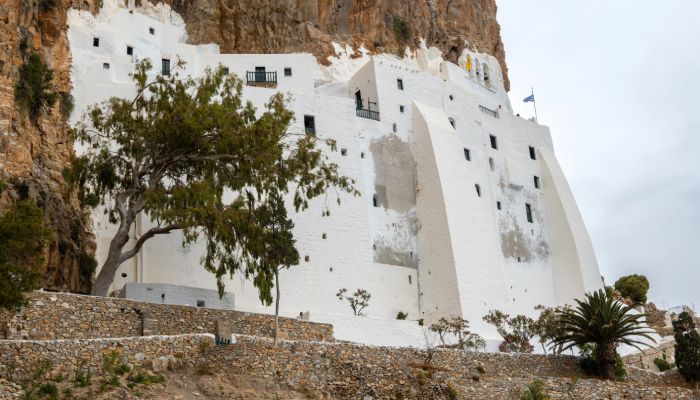
On the island of Amorgos, as on most of the Cycladic islands, you will find hundreds of churches and chapels. A hiking app includes photos and descriptions of as many as 66 of them, while Chora alone has about 30 churches, most of which are privately owned. Most in Chora bear renovation inscriptions, such as the formerly parochial two-storey church of Agioi Panton in 1644, the one-room churches of Agioi Apostoloi in 1689, Agios Ioannos Theologos at the roots of the castle on the north side, Metochi to 1619 of the Patmos monastery of the same name, Agia Theodosia in 1767, near Apano Loza, and others.
Architecture
From the Early Byzantine and Byzantine period there are very few surviving examples, there are many from the 17th, 18th and 19th centuries and most of them belong to the 20th century. Their main characteristic is their simplicity. The chapels are mainly small, one-room churches with tiled roofs. The dome, unlike other churches in the Cyclades, is made of wide slabs in two levels. The final construction is whitewashed, like the rest of the building. In many cases, parts of the ruins of ancient temples, on which they were built, were used as materials.
Most important chapels
- Agios Georgios (Saint George), at the Castle in Chora. It is the first thing you meet as you enter the castle, as it serves as the entrance.
- Panagia Eleousa or Kyra Leousa. It is located under the castle of Chora. It is believed to have been built in Byzantine times. It was the first metropolis and is believed to have housed the icon of the Virgin Mary. The iconostasis has interesting icons of the Cretan school, of which the Virgin Mary Glykofilousa stands out.
- Saint George Valsamitis. It is probably an early Christian basilica. However, indications, such as the existence of a spring inside the later temple, suggest that there was an ancient sanctuary with the character of a reservoir at the same place. In 1967, following a decision by the Bishopric of Thera, Amorgos and the Islands, the point from which the spring was accessed was closed with cement. Until Byzantine times it was an autonomous monastery and then became a part of the Monastery of Hozoviotissa. Access is from the ‘Valsamitis’ path.
- Agia Anna, near the monastery of Hozoviotissa (about 1.5km). It is located on the homonymous beach, the most famous of the island, since scenes of Luc Besson’s film “Endless Blue” were shot there.
- Saint John Chrysostom. The one-room church is located in the craggy area of Kapsala, built in an estate with few olive trees, among ruined buildings and rocks. It bears frescoes dating back to around 1700. Among the representations stand out, in the sanctuary, the Sacrifice of Abraham, the Entombment of the Lord and the Second Coming, and in the nave, St. John Chrysostom and scenes from his life. It is an old metochi of the Holy Monastery of Hozoviotissa. Access is from the path “Old Strata”.
- Panagia Theoskepasti, near the chapel of St. John Chrysostomos. The interesting thing here is that it is built into a rocky outcrop. Access is from the path “Old Strata”. Passing the entrance of the Monastery of Chozoviotissa, you continue north and end up in a gap, from where a small dirt road leads to the church.
- Holy Trinity of Lagada. It was built in a cave, on a steep cliff, during the years of piracy. At that time it was used by the local inhabitants as an occasional hiding place. The temple is accessed by a path, which consists of sixty-five steps.
- Saint John the Theologian. It is built on an ancient temple, parts of which are still visible (built-in archaeological material, ancient inscriptions, as well as architectural parts of Roman and early Christian times). According to tradition, the chapel is called the ‘servile church’ as it had been abandoned for a long time for worship purposes. Access is from the ‘Pan’ trail.
- Temple of the Cross on Mount Krikelos. Continuing along the “Pan” trail, after Saint John the Theologian, you reach the Temple of the Cross, in one of the most inaccessible parts of Amorgos.
- Saint Nicholas, in Kamari of Kato Meria. It is considered a building of the 12th-13th century. It consists of three one-room buildings. A vaulted building of approximately the same length as the nave, without a semicircular arch, has been added to the north aisle, while the south aisle has a ruined cell and then two more cells. On the west side of the church there is a paved courtyard, resting on the remains of a mill or cells. Access is from the “Melania” trail.
- Virgin Mary of the Citizen. You will find this chapel by driving on the provincial road Katapola – Mavris Mytis, just before Kalofana. It is located next to the ruins of an early Christian basilica. In this case too, parts of the ruins were used for the construction of the church.
- Agioi Saranta. It is after Lefkes and next to the torrent of Varma, which crosses the valley. It encloses parts of an ancient temple and elements of early Christian and Byzantine art.
- Virgin Mary Castrian. A spacious, vaulted chapel, built among the archaeological remains in Kastri, the acropolis of ancient Arkesini. There are numerous small stone-built houses, which were used for the accommodation of the faithful who came on the days of its celebration.
All the chapels of the island are interesting, whether they are located in settlements or in the wilderness, in valleys, hills or capes.
Amorgos is a unique destination for religious tourism, as it is rich in churches and chapels, the most characteristic being the Monastery of Panagia Hozoviotissa, which attracts thousands of visitors every year. The island keeps alive its religious customs and festivals, offering an authentic cultural experience throughout the year. To enjoy this spiritual and cultural tour, book your stay at Amorgos Villas, where you will find comfortable and welcoming accommodation that combines quality and warm hospitality, ideal for exploring the religious beauties of Amorgos and having an unforgettable experience on the island.